
Speaking Engagements: What No One Tells You After "Just Do Speaking Engagements"
From poster sessions to keynotes: the honest, unglamorous path no one maps out for you

You’ve seen the thread. Someone posts in a therapist Facebook group or Reddit forum asking what other income streams people have found to offset the cost of running a practice—student loans, startup expenses, the slow crawl of building a caseload. The responses roll in. Some are creative. Some are familiar. And somewhere in the mix, every single time, someone types two words: speaking engagements.
And then nothing. No follow-up. No roadmap. Just speaking engagements, floating there like it’s self-explanatory.
I understand the impulse to suggest it. It’s a real option. But the gap between that comment and actually knowing how to break through as a speaker can feel enormous—especially when you’re already stretched thin trying to figure out how to sustain a practice.
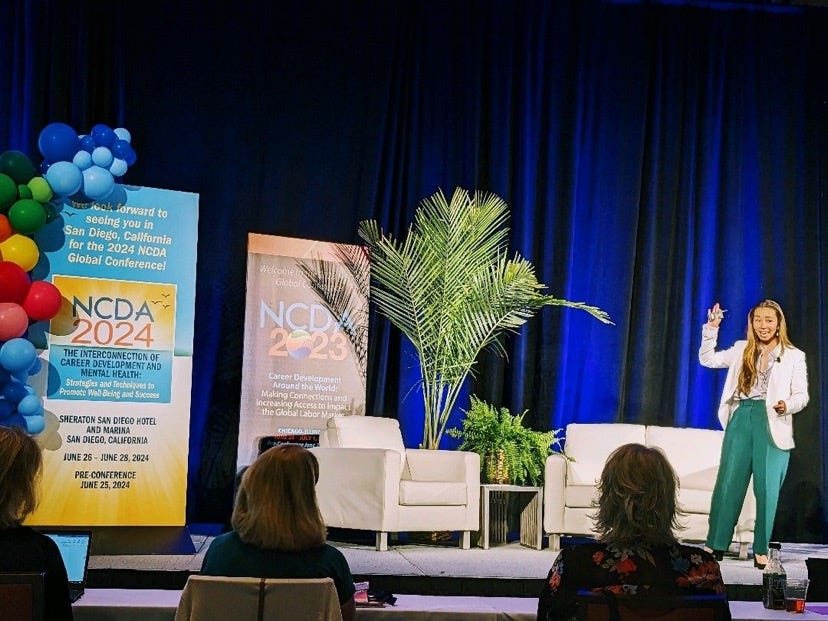
I’ve done a number of speaking engagements over the years. I want to be honest with you upfront: it’s not something I actively rely on as income, and it’s not something I pitch myself for regularly. I know therapists who do—who track calls for proposals, submit to conferences consistently, build their visibility intentionally. That’s a legitimate path. But it’s not the only one, and it wasn’t mine.
What I’m offering here is a behind-the-scenes look at how this has unfolded for me—not a blueprint with guaranteed results, and not a prescription for how it should unfold for you. My ramp-up was a cumulation of years of practice, small opportunities, gradual confidence-building, and a fair amount of stumbling. Others come at this more assertively—pitching themselves consistently, developing a signature talk early, building a speaking brand with real intention. That approach works too. There are multiple valid paths in. I can only speak honestly about the one I’ve been on.
My start was considerably less polished. I was a graduate student, standing nervously in front of a poster at my state counseling conference—answering questions one or two people at a time, hoping I could hold a coherent conversation about my work without visibly sweating. What I didn’t know then was that those moments were building something. Over a decade later, the ease I feel synthesizing information, sharing what excites me about a topic, holding a room—that came from those small, informal exchanges. The keynotes and the honorariums came much later. The poster session came first.
I share that because I think the entry point matters. If you’re genuinely not sure where to begin, start there: in your professional organization, your local community, your training program’s alumni network. Offer your time—thirty minutes, an hour—to speak on something you know well. It doesn’t have to be groundbreaking research or an original theory. The originality comes from your perspective, your clinical lens, the way you frame something that might otherwise feel inaccessible.
Accessible and compelling is its own kind of expertise.
A note on definitions before we go further.
When I talk about speaking engagements here, I’m referring to conference presentations, keynotes, panel appearances, and community talks—situations where you’re being brought in to share expertise with a live audience. Training is adjacent but distinct in my mind: it typically involves skill-building, continuing education credit, and a more structured facilitation role.
That said, the line isn’t always clean. I’ve been to conferences where a keynote or featured presentation was also approved for continuing education credit—which means the same talk that reads as a speaking engagement on your end is functioning as a training on the attendee’s end. It happens more than you’d think, and it’s worth knowing that your expertise can carry CE value even when you’re not designing a formal training curriculum. The distinction I’m drawing is less about the format and more about the intent: are you primarily there to share a perspective and move a room, or are you primarily there to build a skill? Both matter. They just require different preparation and different expectations going in.
For the purposes of this piece, we’re focused on speaking engagements—but if the CE conversation is something you want to explore further, that’s a whole other essay.
Before you pitch anything: get clear on your lane.
This is the step most people skip, and it’s the one that makes everything else harder. Before you start reaching out to conferences or submitting to calls for proposals, you need to know what you want to be known for on stage—not “mental health” broadly, but something specific enough that when someone hears you speak once, they walk away understanding something differently than they did before.
That’s your signature lens. And it’s worth sitting with before you start saying yes to things.
For therapists, strong lanes often emerge from the intersection of who you serve, what you see every day in the room, and what you believe the field is still getting wrong. The clinician who works with bicultural families and has thought deeply about identity and belonging has something to say that a generic wellness speaker doesn’t. The supervisor who’s spent years watching training gaps play out in real clinical situations has a perspective that a textbook can’t offer.
You are not just a mental health professional. You are a particular kind of mental health professional with a particular vantage point. That vantage point is where your speaking life begins.
A useful prompt to sit with: If someone hears me speak once, what do they walk away understanding differently? That answer is your throughline.
The “two or three topics” question—and where I land.
There’s a common piece of advice in speaker circles: pick two or three topics, develop them deeply, and repeat them. Get so familiar with your material that you barely need your slides. The plus side is real—repetition builds confidence, and confidence is what makes a room lean in. A signature talk becomes shareable. It becomes your brand, the message people associate with you, the thing conference coordinators think of when a slot opens up.
But I tend to tailor my engagements to the event itself—the theme, the audience, the priorities the planning committee is working around. A cookie-cutter talk doesn’t always serve a room that has specific needs, and I’d rather arrive curious and prepared than efficient and generic.
These approaches aren’t opposites—they’re a spectrum, and most working speakers live somewhere in the middle. Build two or three core talks you know well, then adapt them for context without reinventing from scratch every time. The core throughline stays intact; the framing shifts to meet the room.
Try this: Draft a working title and a two-sentence description for one talk you could give right now. Don’t overthink it. What do you find yourself explaining to colleagues, supervisors, or students on a regular basis? That’s likely your first talk.
Start before you feel ready.
If getting in front of a room still feels like too much, start with an online presence. I love writing—and for me, that was its own kind of beginning long before I ever stood in front of an audience with intention. A newsletter, a blog, consistent posts about what you’re thinking about clinically. If someone reads it, wonderful. But that’s almost beside the point. At minimum, it signals what you care about, what you find worth discussing, what you’d show up to talk about if someone asked. It plants a flag. And sometimes that flag is what gets you invited into rooms you weren’t actively pursuing.
When you’re ready to be in front of people, one of the most underused entry points is also one of the most low-stakes: co-presenting. I did this regularly as a graduate student, and it made a meaningful difference in how comfortable I became in professional settings before I ever had to hold a room on my own. Find a colleague, a classmate, a supervisor—someone whose thinking complements yours—and submit together. You split the preparation, you split the nerves, and you get to watch how someone else handles the parts that feel uncertain to you. Conferences are often more open to proposal submissions than people assume, especially at the regional and state level. You don’t have to be an established name to get on a program. You have to have something worth saying and be willing to submit.
If a conference still feels like a stretch, offer to present at a colleague’s group practice, run a lunch-and-learn for a local nonprofit, or do a joint workshop with a friend to a room of ten people.
The audience size doesn’t determine the value of the practice. What you’re building is your relationship to being in front of people—the pacing, the pivots, the comfort with silence, the recovery when something doesn’t land the way you expected.
That only comes from doing it.
Before you can send anything: the basics you need ready.
Before a speaker kit, before a pitch email, before anything else—you need two versions of your bio. Not because it’s glamorous prep work, but because you will be asked for both, often with little notice, and scrambling to write about yourself under a deadline is its own particular misery.
Your short bio is typically two to four sentences—the version that appears in a conference program, gets read aloud before you take the stage, or sits beneath your headshot on an event webpage. It should include your credentials and current role, one or two specific areas of focus or expertise, and something that signals why you on this topic. Keep it tight. The goal is orientation, not a full introduction.
Your long bio is typically one to two paragraphs and lives in speaker kits, proposal submissions, and anywhere someone needs a fuller picture before deciding whether to book you. It has room for more context: your clinical background, populations you work with, any relevant writing, speaking history, training roles, or professional affiliations. It can have a slightly warmer register than a CV—this is where a bit of your voice can come through. But it’s still a professional document. Lead with what’s most relevant to a booking decision.
A few things worth including across both versions, depending on length: your licensure and any relevant certifications, your practice or institutional affiliation, specific clinical areas or frameworks you work within, notable speaking or training history, and a line about who you typically serve or what you believe about the work. That last one is often what makes a bio memorable rather than just informative.
Write both now, while you’re not under pressure. Save them somewhere you can find in under a minute. Update them when something significant changes. You will use them more than you think.
A simple speaker kit goes further than a long email.
What you need is something you can send when someone asks who you are and what you talk about—a one-page PDF or a simple webpage that does the work of a long email without requiring one. Include your bio, two or three talk titles with brief descriptions, a note about who each talk is designed for, any prior speaking you’ve done, a photo, and contact information. That’s it. Past experience—even modest experience—signals credibility. A conference presentation, a guest lecture, a panel appearance: include it. People are looking for confirmation that you’ve stood in front of a room before, not a TED résumé.
Each talk should have a clear throughline, a few frameworks translated into accessible language, grounding in your own clinical experience, and something the audience can leave with. People pay for practical takeaways. They remember the moment when something clicked. Build toward that.
Where to look for opportunities—especially early on.
The best places to start are the ones where you already have proximity. Professional organizations you’re already a part of. Universities with counseling programs or graduate students who need exposure to practicing clinicians. Nonprofits serving communities you know well. Group practices. Hospital behavioral health departments. Local conferences before national ones.
You already have more of an ecosystem than you might realize. Relationships with colleagues, institutional connections, professional networks you’ve been building for years—these are your first tier. Not because they’re lesser opportunities, but because warm introductions and existing credibility make everything easier.
You’re not starting from zero. You’re starting from where you already are.
On pitching: you are offering value, not asking permission.
Keep it relational and specific. A short email that explains who you are in a sentence or two, names something particular about why you’re reaching out to this organization or event, and offers one or two talk ideas relevant to their audience will always outperform a general inquiry.
A rough template to work from:
Hi [Name], I’m a [your role] based in [location], and I do a lot of work around [your lane]. I’ve been thinking about your [team/students/community], especially given [something specific about them], and I’d love to offer a talk that supports [their need]. A couple of topics that might be relevant: [Talk title one] and [Talk title two]. Happy to share more or tailor something specific.
You are not asking for a favor. You are offering something that could serve their audience. Hold that distinction—it changes the energy of the message.
Questions I ask before I accept a speaking engagement.
Before I commit to anything, there are a few things I want to know. Getting comfortable asking these questions is part of treating your time as a professional resource.
Who is the audience, and what do they already know? A talk for a general community audience and a talk for licensed clinicians require entirely different calibration. Assumed knowledge matters. Developmental level within the audience matters.
What is the event’s theme or focus, and where does my piece fit? I want to understand what’s happening before and after me, what the organizing committee is trying to accomplish, and how my contribution supports that.
What are the logistics? Length, format, whether there’s a Q&A, whether I need to submit materials in advance, whether there’s an honorarium or travel coverage. These aren’t awkward questions. They’re professional ones.
What is the audience expecting to leave with? A takeaway-driven audience wants practical tools. A reflective audience wants framework and language. Knowing the expectation helps you meet it.
(Not an exhaustive list, but I hope it helps you think before saying yes!)
On compensation: a rough orientation.
I want to be honest about how this actually progressed for me, because I think the sanitized version of this conversation doesn’t help anyone.
I volunteered my time first. For a while, that made sense—I was building experience, establishing credibility, getting comfortable in rooms I hadn’t been in before. Then sometimes a small stipend or honorarium was offered without my asking. Sometimes travel or lodging was covered. And then there were times when nothing was offered, and I had to ask—and it was uncomfortable. It still is, if I’m being truthful. Knowing your worth in the abstract and actually naming a number out loud in a negotiation are two very different things, and I haven’t fully perfected the latter.
What I have had, though, is the gift of watching other women in my life do it well. Women I admire deeply—who move through those conversations with a kind of grounded certainty that says: my time and expertise have value, and free labor is not on the table. I’ve tried to emulate that. I’m still learning it. But having it modeled for me made it possible to practice, even when it felt uncomfortable, even when I stumbled through it.
I share that because I think a lot of us—particularly those of us who were socialized to be accommodating, to be grateful just to be in the room—carry a particular weight when it comes to these conversations. The discomfort is real. It doesn’t mean you’re doing it wrong.
And it wasn’t just the money conversations that required that kind of nerve. Sometimes I had to let people know I was interested in the first place—that I wanted to be considered, that I was available, that I had something to offer. That felt like self-promotion in the most uncomfortable sense of the word. Shooting your shot, sitting with the silence after, tolerating the possibility of rejection. We ask our clients to do this all the time—to take risks, to advocate for themselves, to move toward discomfort in the service of something they want. Stepping into that same bravery myself is something I am still actively learning. I don’t think it fully goes away. But I’ve come to believe that getting more practiced at not letting rejection stop you is part of the work—for us just as much as it is for the people we sit with.
As a rough orientation on numbers: smaller organizations and nonprofits tend to fall in the range of a few hundred to around fifteen hundred dollars. Universities, hospital systems, and mid-size conferences often go higher. Corporate and workplace speaking—especially DEI-focused engagements—commands significantly more.
I’m sure others calculate this differently, but here’s how I think about it: I add up my preparation time, travel, any back-and-forth communications with the planning committee, and the length of the engagement itself—then I hold that total up against my standard out-of-network hourly rate. That gives me a baseline before I enter any conversation about compensation. It doesn’t always determine what I charge, but it keeps me honest about what I’m actually exchanging—and it means I’m making a conscious choice rather than just accepting whatever number gets offered. When you don’t have full visibility into a budget yet, it’s not unreasonable to say: “I’m happy to discuss options depending on scope.”
The goal isn’t to price yourself out of opportunities. The goal is to not chronically underprice yourself because the conversation feels uncomfortable.
Before you walk in: two things most people don’t prepare.
The first is a short list of people who can speak to your work—colleagues, supervisors, or past clients who know what you bring to a room and would be willing to say so. After a talk goes well, someone in the audience may want to know more before they book you. Having a name or two you can point them toward—with permission—carries more weight than anything on your speaker bio.
If you’ve worked with someone who experienced your clinical work or your training and you have a genuine relationship, a gentle ask for an endorsement is appropriate. Most people are glad to be asked. What makes it land well is asking specifically—not “would you say something nice about me” but “would you be willing to share a sentence or two about your experience working with me, specifically around X?” The specificity makes it easier for them and more useful for you.
The second thing to prepare is a way for people to reach you. This sounds obvious, and yet. I have been genuinely surprised—more than once—by who was sitting in the audience. A potential collaborator. Someone building a program who needed exactly the perspective I’d just shared. A journalist working on a piece.
You cannot predict who shows up, which means you have to be ready for it when they do.
I want to be specific about this because I think it’s undersold: some of my most meaningful speaking opportunities didn’t come from pitching myself or submitting proposals. They came from someone sitting in the audience at a conference or training who approached me afterward and asked if I was available for something else entirely—a different event, a different organization, a different context I hadn’t been thinking about at all. That has happened more than once, and it’s shaped how I think about every room I walk into. You are not just there to deliver a talk. You are there to be known. And the people who come to know you in one room are often the ones who open the next door.
A business card still works. A QR code to your website or newsletter works. A verbal mention of where people can find you before you close works. Whatever it is—have it ready, and say it out loud. Don’t wait for people to find you afterward. They won’t always. But if you make it easy, some of them will.
One talk, many doors.
Before we talk about what a single talk can become, let’s talk about the follow-up—because this is where a lot of people drop the thread.
After an engagement, send a thank you. A note, an email, something that acknowledges the people who invited you in. And if it’s within your means, a small gesture—a card, something simple—goes a long way. This isn’t transactional. It’s a matter of respect and community. When someone invites you to speak, they are bringing you into a space with their colleagues, their students, their people—people they have relationships with and feel some responsibility toward. That’s not a small thing. Honoring it, even briefly, signals that you understand the weight of the invitation and that you don’t take it for granted. In my experience, that kind of follow-through is remembered. It’s also just the right thing to do.
From there: a single talk—well-developed and well-received—can become a paid workshop, a CE training, a recorded course, a keynote, a Substack essay, or the foundation of a consulting offering. The content you develop for one context rarely has to live only there. Ask for a testimonial. Ask for a referral. Ask who else you should be talking to. One room consistently opens into the next—but you have to be willing to ask.
What will actually make you good at this.
Being booked and being in demand are different things. What closes that gap has less to do with your credentials and more to do with how you show up.
Your voice is your differentiator. The ability to name what people have felt but couldn’t articulate—to take clinical insight and translate it into language that lands—is not as common as you’d think. That’s not lecturing. That’s creating a moment of recognition, which is what people remember long after the content fades.
The best speakers feel like: this person gets me. Not: this person is impressive. The distinction matters more than most of us were taught to believe.
And stay clinically grounded. It’s your edge. You’re not a motivational speaker and you’re not just an educator. You’re someone with training, direct clinical experience, and a framework for understanding why people struggle and what they need.
That combination is rarer than the forum comment suggests.
Before you close this tab: a starting sequence.
Work through this in order, not all at once.
Clarify your lane. Answer this in writing—not a topic, a perspective: if someone hears me speak once, what do I want them to understand differently? If you’re struggling to see yourself in that space, ask someone who knows your work. A trusted colleague, a friend who has collaborated with you or even watched you work behind the scenes—their perception of what you bring may illuminate something you’ve been too close to see yourself. Sometimes others hold the image of us we haven’t yet claimed.
Start with an online presence if going out feels like too much. A newsletter, a blog, consistent posts about what you’re thinking about clinically. No stage required. No deadline. If someone reads it, great—but that’s not the point. The point is that your perspective is now findable.
Draft one talk. A working title and two to three sentences—what it covers, who it’s for, what someone leaves with. You’re not committing to anything. You’re giving yourself something concrete to work from.
Write your bios. Both versions, before you need them. If you skipped that section earlier, go back. Keep them somewhere you can find in under a minute.
Build your speaker kit. One page. Bio, talk descriptions, who they’re for, past experience, photo, contact. Done.
Identify three places to start. Look at the ecosystem you already have and pick three places where a warm introduction or existing relationship already exists. Those are your first outreach targets.
Take one action this week. Submit a proposal. Send one email. Ask a colleague about co-presenting. One thing. The momentum comes from doing, not from planning to do.
Know your number. Add up your prep time, travel, communications, and the length of the engagement, and hold it against your out-of-network hourly rate. Know what you’re willing to accept and why—before you’re in the conversation.
Prepare your social proof. Identify two or three people who could speak to your work and reach out when the time is right. Start collecting testimonials after every engagement, however small.
Have a way for people to reach you. Before every talk, decide what you’ll say out loud at the close. Say it every time.
Follow up. After every engagement, send a thank you. If a small gesture is within your means, send that too. Then ask: for a testimonial, for a referral, for a name. The relationship doesn’t end when you leave the room.
And a few questions worth sitting with as you move through this:
What do I want speaking to do for my practice or career—visibility, income, relationships, something else? The answer shapes which opportunities are worth taking and which ones to pass on.
What am I willing to do for free, and for how long? Strategic generosity is real. Chronic undervaluing is also real. Know the difference before you’re in the room.
What does rejection mean to me, and how do I want to respond to it? You will not get every opportunity you pursue. Having a framework for that ahead of time makes it easier to keep going.
Who in my life models this well—the asking, the pricing, the visibility—and what can I learn from watching them? You don’t have to figure this out alone. You probably already know someone doing it in a way that resonates. Pay attention.
Speaking engagements are not a passive income stream—let me be clear about that. They require preparation, often significant preparation, and the payment is frequently not proportional to the work involved. What they can offer is visibility, credibility, and the kind of slow-building reputation that eventually opens other doors. If you approach them strategically and with realistic expectations, they’re worth it.
If you approach them hoping to offset your business expenses by next quarter, you may want to revisit the plan.
But if you’re standing nervously in front of a poster somewhere, answering questions one or two people at a time? Stay there. That’s where it starts.
Love the information. Saved for detailed read later.